
Imagine you are an ancient Roman citizen. You wake up, do your chores, and make an offering to Father Tiber to keep the floods at bay. After your chores, you plan to go to the baths. On your way, you pass through public fountains, both for display and drinking. You even pass big houses with their own private running water. As you walk, you may ask someone if they knew where the water came from. You would be told about the aqueducts. Then you may think, “Well, what are the aqueducts? What are they made of?” While this article cannot reach you in ancient Roman times, it can detail what the aqueducts were, what they were made from, and the chemistry behind the building materials. While this paper will be a simplified overview, it aims to investigate the reason why the aqueducts worked so well and why they still stand thanks to their materials.
What Were the Ancient Roman Aqueducts?
While the ancient Roman aqueducts can be summarized in a few sentences, that does not necessarily mean they should be. The beauty of the aqueducts is the simplicity of the Romans’ tools and science knowledge, yet the complexity of their engineering in the construction of the aqueducts, the parts designed, and materials used.
Overview
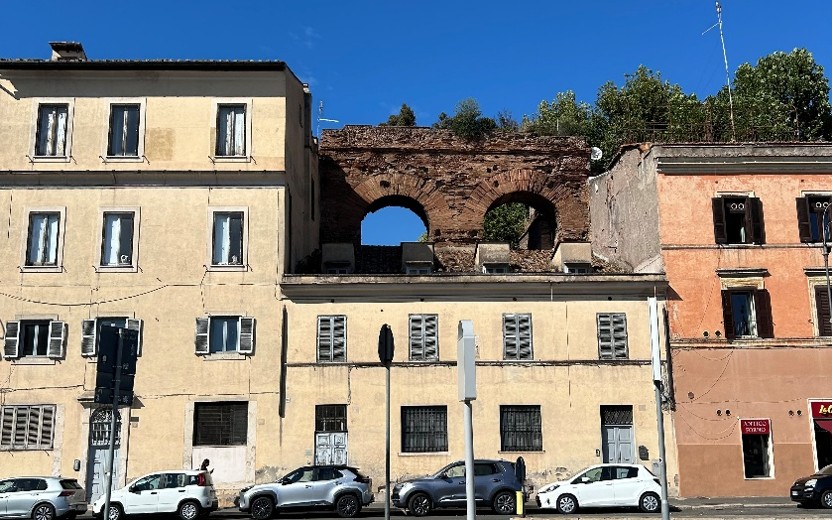
The Roman aqueducts, now marvels of ancient history and obstacles to construction (See Figure 1), were once one of Rome’s main sources of clean, drinkable water. The seemingly endless stretches of arches, tunnels through mountains, and sophisticated distribution systems brought water from springs, lakes, and rivers into the city. There are eleven major aqueducts that fed directly into Rome. They supplied public drinking fountains, display fountains, public baths, and even private residences (Murray, 2026). The first major aqueduct was the Aqua Appia, built in 312 B.C. which connected Rome to a spring 16 km way (Aicher, 1995). This aqueduct resembled the Roman drainage system more than it did the aqueducts that followed it, because they used already dug drainage tunnels (Aicher, 1995). The aqueducts continued to be built for the next 537 years, usually out of need for more water for the growing population (Aicher, 1995). The last aqueduct to be built was the Aqua Alexandrina, specifically built to feed the Baths of Nero in 226 A.D. (Aicher, 1995). But while the aqueducts are spectacles of human history, they are also testament to human engineering.
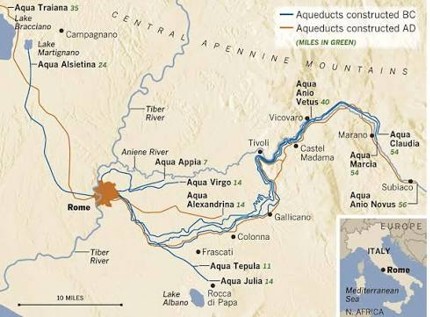
As shown in Figure 2, the aqueducts came from near and far to the city from different sources. As in the case of the Aqua Virgo, the source was a marsh, 22.5 km (14 miles) from the city (Aicher, 1995). To cover those distances, the Romans had to use great engineering knowledge by building arches and tunneling to connect the city to water. However, the length of the aqueducts was not the only thing that made them a testament to the Roman’s engineering ability; so were the slopes of the aqueducts themselves. The aqueducts moved water only by gravity. This meant that, within the channels, they worked with construction gradients averaging between 0.3% and 0.15%, with extremes of 0.007% and 3.0% (Dembskey, 2009). As I saw within the Aqua Marcia, the gradient was so small, it was invisible. Even with the limited tools and math they had, the Romans were still able to craft painstakingly small gradients along great distances. But the Romans did not just build sloped channels and called it a day. There are many important parts to the aqueduct that kept it functioning.
The Parts of an Aqueduct
While the overview of the aqueducts is technical information for the aqueduct as a whole. The parts of the aqueduct, independently, are just as important. The aqueduct would have been unable to provide and distribute clean water without the arcades, settling tanks, castellums, and more.
Arcades, Bridges, and Substructions
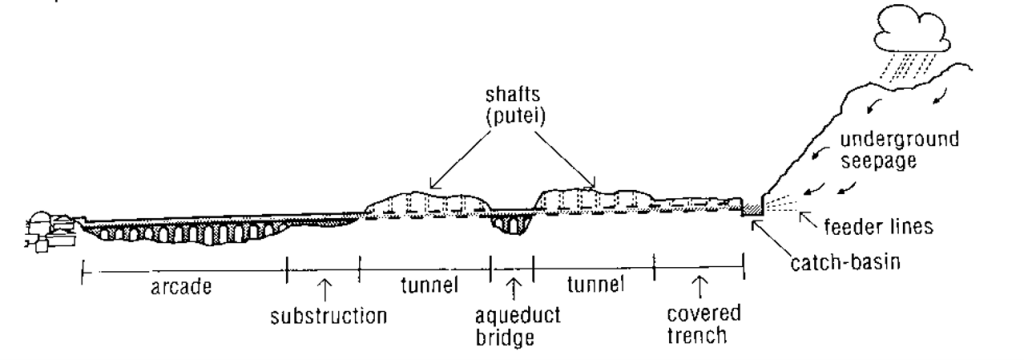
Arcades, bridges, and subtractions are the main things people think about when discussing the aqueducts. The arcades and bridges were used when a valley inhibited the ability to tunnel. A subtraction, a “substructio,” was used when a hill or minor dip affected tunneling (Aicher, 1995; Dembskey, 2009). As seen in Figure 3, while all three are elevated sections of the aqueduct, they differed by height. Subtractions were a low laying wall, while the heights of arcades and bridges required arches (Aicher, 1995; Dembskey, 2009). Arches were used to hold these sections because they used less material, took up less space, and were stronger than regular walls (Aicher, 1995; Murray, 2026). In addition, the difference between arcades and bridges is length. An arcade covered a vast distance, see Figure 4, while bridges covered smaller distances (Aicher, 1995). During my time exploring the remains of a couple aqueducts, I saw that arcades are an unofficial symbol of the aqueducts because of how many sections of them still stand. This highlights how the materials used are long-lasting and reliable for the outcome they wanted. Nonetheless, while all three are impressive and amazing pieces, they were not the favored parts of the aqueduct for many reasons.
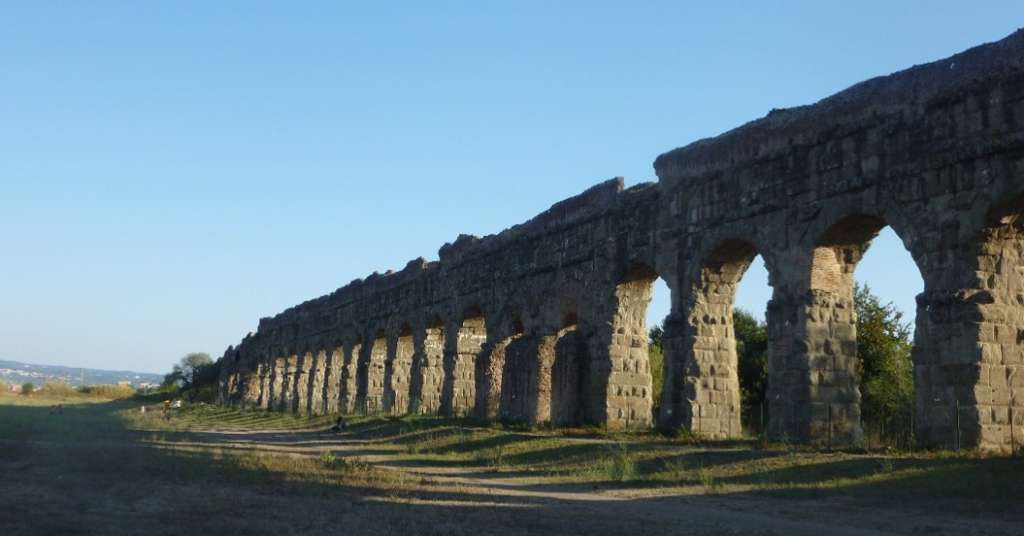
In examining a subtraction, it was simply walls with a bottom. It had no top to cover the water flow and was therefore open to debris. Arcades and bridges, while sometimes covered, also struggled with other issues. The three kinds of structures were vulnerable to damage from earthquakes, weather erosion, and invasions. They also cost more money compared to alternatives in building materials, manpower for construction, and repairs after damage (Dembskey, 2009). That is why the alternative, underground tunnels, were favored.
Tunnels
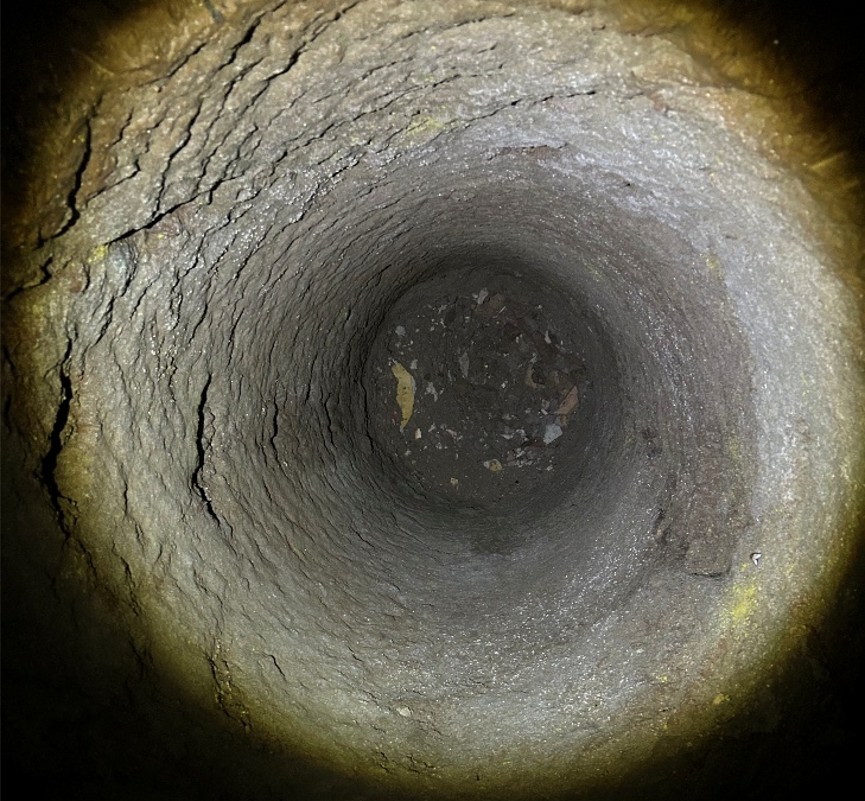
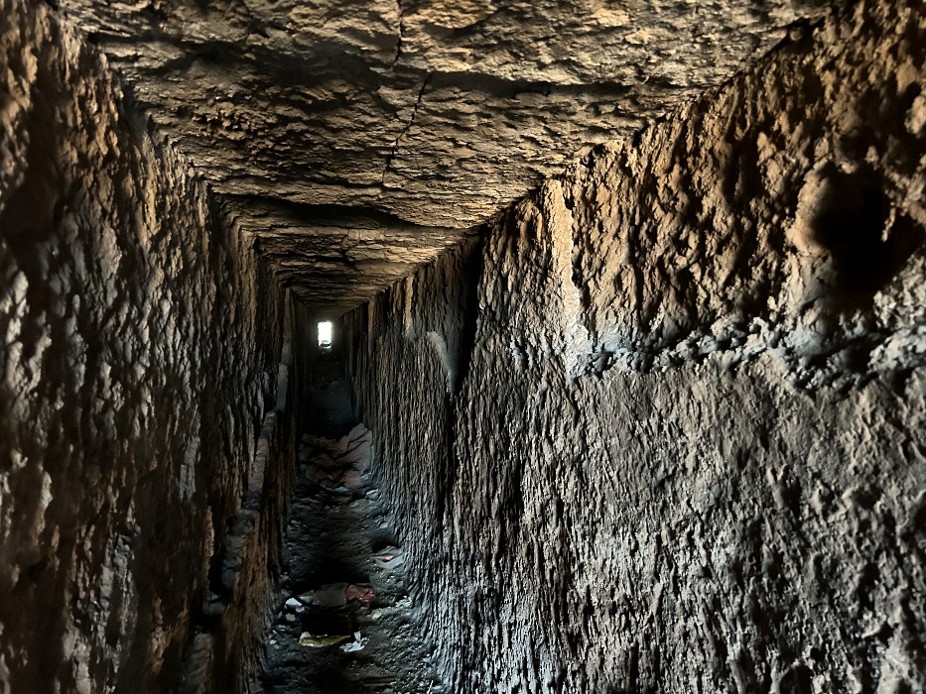
Eighty percent of the aqueducts were underground (Aicher, 1995; Dembskey, 2009). They suffered less damage from natural and human causes and were cheaper to build and repair. Tunnels were created either by craving out rock at both ends simultaneously or digging a trench and adding a celling (Aicher, 2009). While the size of the channels varied, they were roughly 1 meter wide and 2 meters tall. The channels also had shafts, “puteus,” every 25-60 meters that were placed to allow humans into the tunnel. (Dembskey, 2009; Morabito, personal communication, 17.9.2026). As seen in Figure 5, the shafts were just big enough for men to get down. Once in the tunnels, work consisted of repairing channels after earthquakes, clearing off the mineral build up that affected water flow, or cleaning the settling tanks (Aicher, 1995; Dembskey, 2009). While I was in the Aqua Marcia and under the Temple of Maximum, I got to experience how small the tunnels and shafts really were. My shoulders were the diameter of the shaft and the tunnel, but I was tall enough (5’7”) to stand up straight in the aqueduct. Much like today’s engineers, the Romans did not carve out or build larger than they absolutely had to for these aqueducts. But while the tunnels carried the water to the city, the Roman’s designed parts to catch, clean, and distribute water.
Catch Basins, Settling Tanks and Castellums
The water had to reach the arcades and tunnels somehow. The Romans then created catch basins. Catch basins differed depending on the kind of source for the aqueduct. Nonetheless, the design for a spring source, the majority of the eleven aqueducts, consisted of multiple “feeder branches” that led water from the spring into the basin (Aicher, 1995; Murray, 2026). Once water entered the basin, it then flowed into the main channel and down the aqueduct. But along the way, it would also be cleaned using settling tanks.
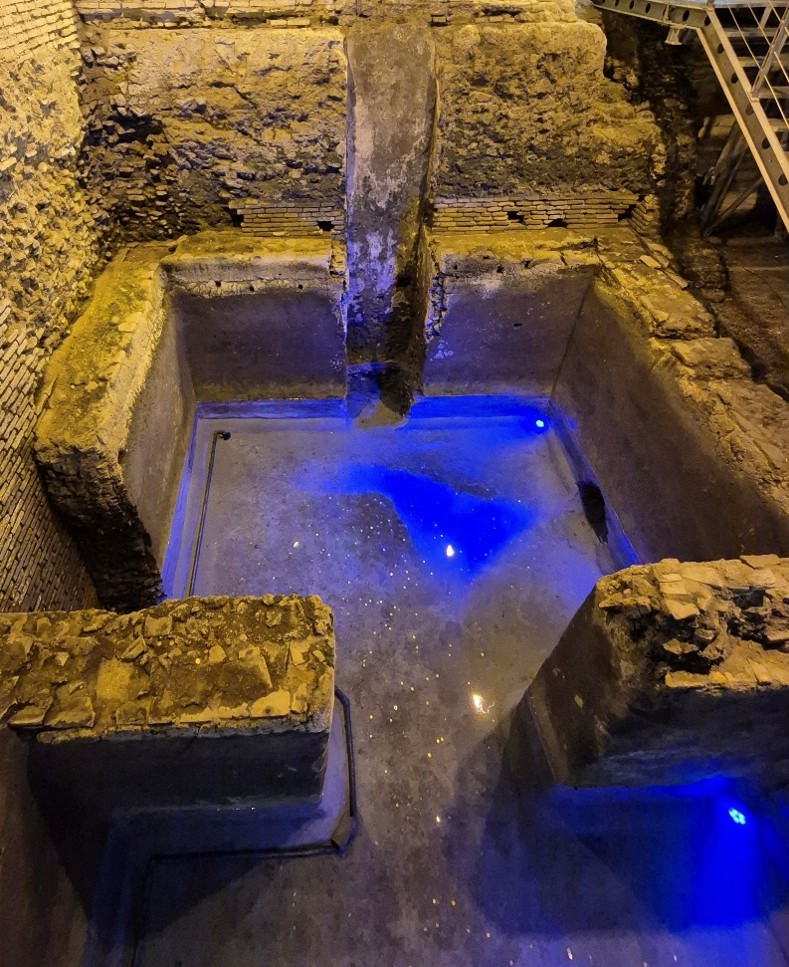
Settling tanks were put in along the tunnel so that water slowed down but passed over the opening to the tank and more dense impurities were left behind. They could be in the beginning, in the middle, or the end and there could also be multiple depending on the aqueduct (Aicher, 1995; Dembskey, 2009). Sometimes the tanks were more complex, as in the Aqua Virgo’s (see Figure 6). The water passed through two layers of settling tanks to allow more particles like sand and rocks to fall out of the stream (Aicher, 1995). However, these tanks were not the most equipped for handling larger debris from river sources. They combated this, at least in the Anio Novus, by moving the catch basin up to a dammed part of the river that acted as a large settling tank. Nonetheless, after the water was cleaned and passed through the aqueduct, it had to be distributed.
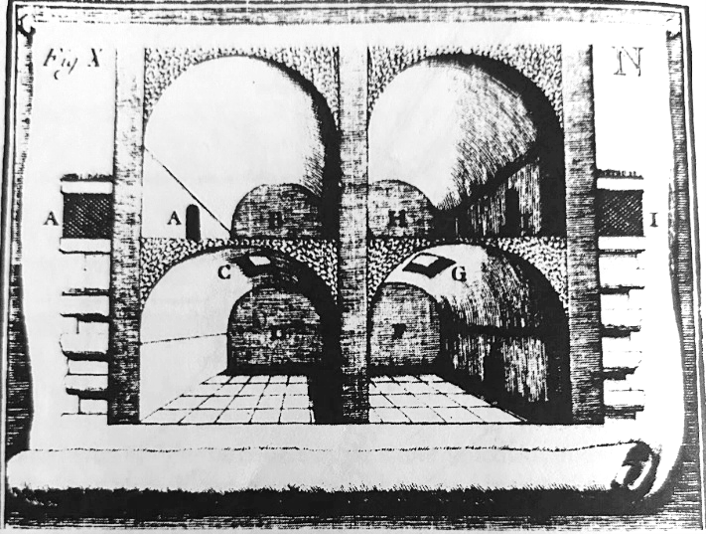
Castellums were a vital part of the aqueduct. They are closely related to today’s water towers since they acted as distribution systems for the city. Water would enter the castellum then be dispersed through lead or terracotta pipes (Aicher, 1995). As seen in Figure 7, the castellum collected water from the Aqua Virgo, then distributed out it to the district through the holes at the bottom. If there was more than one pipe to distribute water, these pipes were placed at different heights. As described by Vitruvius in book 8, chapter 6, sections 1 and 2, “When it [aqueduct] has reached the city, build a reservoir with a distribution tank…From this central tank, pipes will be laid to all the basins and fountains; from the second tank, to baths, so that they may yield an annual income to the state; and from the third, to private houses, so that water for public use will not run short.” Castellums, while a beautiful example of hydraulic engineering, were not the only part that used pipes, so did Siphons.
Siphons
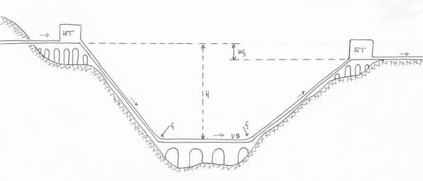
While not used in the main eleven aqueducts that fed ancient Rome, siphons are still remarkable. Much like arcades, bridges, and subtractions, they were used to cross a valley where tunneling was not possible. However, siphons used pressure in lead pipes to transfer water and did not solely relay on gravity (Aicher, 1995). As seen in Figure 8, where the water was coming from, at the top of a valley, was slightly higher than where it was going after the valley. Siphons were used when a valley was bigger than 50 meters (Aicher, 1995). Water entered a basin from the channel, that becomes airtight and pressurized. It then descended the valley and was forced back up the other side to a slightly less higher basin Aicher, 1995). Siphons were complete marvels of engineering in ancient Rome. The Romans were able to build systems that manipulate pressure just to provide water for their people. Nonetheless, they could not have built siphons, arcades, castellums, and the aqueduct overall without their selective materials.
The Who, What, When, Where of Materials
The materials of the aqueducts are just as important, if not more important than the parts of the aqueducts. While their materials happened to be near, easy to get, and cheap to transport or combine, it did not make them any less useful. Over the 537 years of the aqueducts being built, the Romans changed some materials or methods, but they mainly stayed true to what they knew. Since building the aqueducts was an expensive endeavor, the Romans did not shy away from stacking aqueducts together, see Figure 9. This meant that the different materials used for different pieces and time periods can be seen together.
Concrete and Bricks
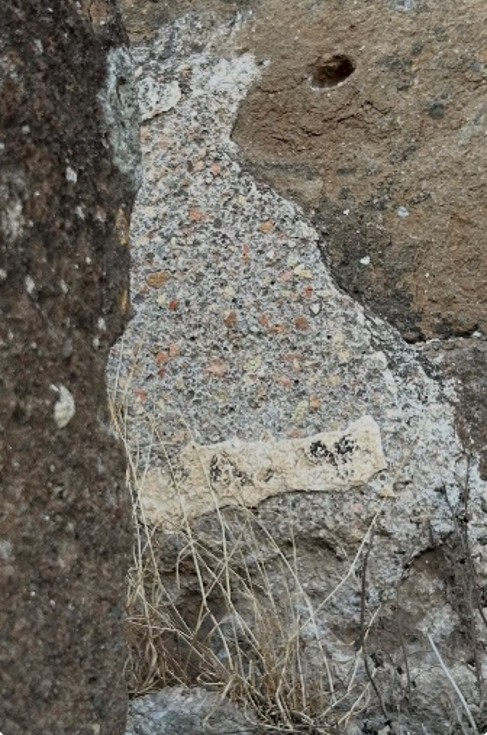
Bricks and concrete have been found all over Rome because both materials have been used for centuries. Bricks-and-mortar were commonly used as a formwork, called “opus latericium,” and that form was filled in with Roman concrete (Flohr, 2025; Dembskey, 2009). However, both were found in the Roman aqueducts. Concrete was found within arcades, bridges, and channels. While it was used as a space filler, it was also used to line the channels built out of stones or dug trenches (see Figure 10) (Dembskey, 2009). It was typically made from volcanic ash (pozzolana), water, quicklime, and larger pieces of rock, brick, or pottery (Wayman, 2011). Bricks, on the other hand, were used similarly to concrete, but were usually just formwork. They were used in arcades, channels, settling tanks, etcetera (Aicher, 1995; Malinowski, 1979). Nonetheless, the production of bricks also had to be a big deal because they used so many.
Brick Making
The process of making sun-dried bricks was outlined by Vitruvius. In book two, chapter three, Vitruvius stated that “They [bricks] should rather be made of white and chalky or of red clay, or even of a coarse-grained gravelly clay… Bricks should be made in Spring or Autumn, so that they may dry uniformly.” While Vitruvius outlined how the Romans originally made bricks by hand, they used so many that they began to mass produce them. They produced bricks through a combination of manual labor and kilns, but not much is known past that (Scalenghe et al., 2015). Based on Scalenghe et al. (2015)’s experiments, the type of soil, and their slightly differing chemical composition, did not matter to the outcome of the bricks. But what did matter was the temperature of the kiln. Between 400 – 650 ℃, water began to evaporate off the clay, 700 ℃ made decent, red- brown pottery, while the maximum kiln temperatures of 1200-1300 ℃ created an incredibly strong material (Scalenghe et al., 2015). Nonetheless, the bricks and concrete of the aqueducts did not directly interact with the water like other materials.
Mortar
While mortar is typically associated with bricks, the Roman’s also used a waterproof mortar all throughout the channels of the aqueducts. This kind of mortar was called “opus signinum.” From research, and my own observations, the mortar was in arcades, bridges, substructions, tunnels, etcetera (Malinowski, 1979). It was one of, if not, the most important material used for the aqueduct. The mortar mixture was water, quicklime, pozzolana, and ground up pottery (see Figure 11) (Delatte, 2001). It was typically placed 2/3 up the wall, where max water flow was (Dembskey, 2009). This mortar, as the chemistry will show, allowed water to easily glide within the channels, be protected from anything coming in, and made it so that water could not escape (Dembskey, 2009). As I saw in the Aqua Marcia arcade tunnel and the castellum of the Aqua Virgo, not only does the mortar remain, but it also still works with its intended purposes. Even so, opus signinum was not the only sealant used in the aqueducts.
Selant
Selant, in this paper, will refer to the sealing material used on the pipes within Roman siphons. To make sure the siphon system was airtight and pressurized, they sealed the pipes. They did this with a substance made from quicklime and olive oil (Malinowski, 1979). Originally a Greek invention, Vitruvius stated it was passed down to the Romans (Book 8, Chapter 6, section 8). While simple, chemistry will find that it was extremely productive for what they were using it for.
Rocks
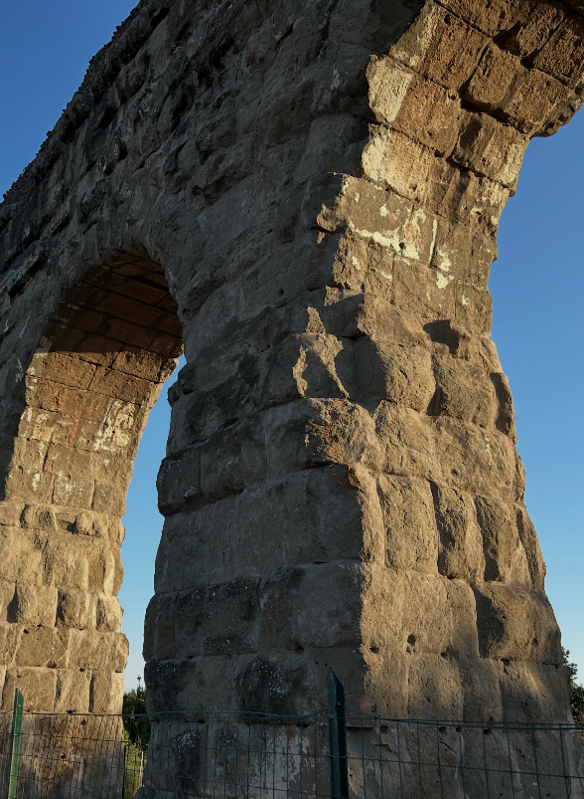
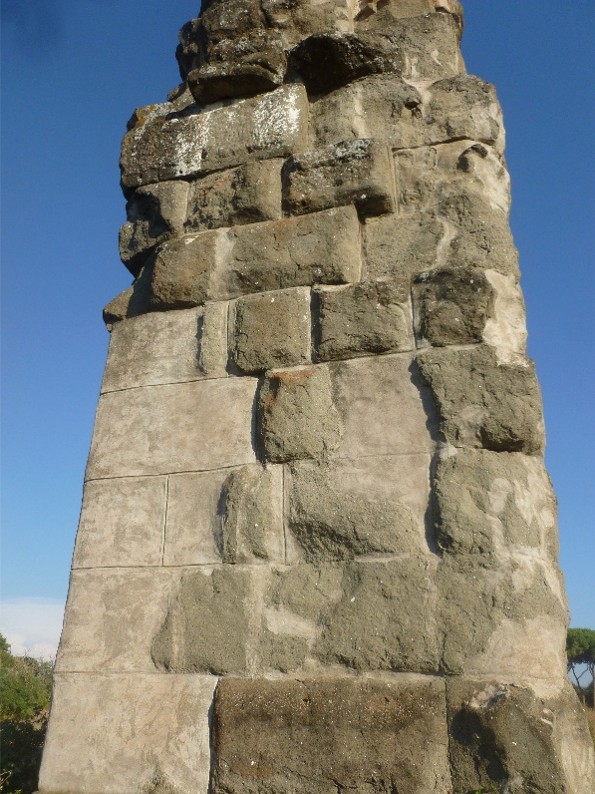
Rocks, while a broad and simple term, were extremely important to the aqueducts and building them. Volcanic rocks, specifically tuff, were the most important. “Stony” tuff called “tufa litoide,” was used as building blocks for the arcades and bridges, and pieces of it were used as concrete filler (Dembskey, 2009). As seen in Figure 12, the arcades of the Aqua Claudia were made of stony tuff with no mortar in between the blocks. Tuff was typically used because it was found close to Rome and was easy to chisel before it would harden after prolonged exposure to air (Aicher, 1995). Similarly, “sandy” tuff is the ever-famous pozzolana in the waterproof mortar (Dembskey, 2009). Found in concrete, mortar, and sealant, pozzolana was used for its properties and easy accessibility. Like many engineers, the Romans used what was near, cheap, and worked. They preferred spending less money and staying to the tried-and-true methods. As thousands of years have shown, those cheaper, close, and known materials are still standing, thanks to a mix of geographic luck and chemistry.
The Why (Chemistry) of Materials
While bricks, rocks, mortar can be physically touched and worked with, each one of those things has properties that are important to their jobs because of their chemical make-up. By looking at the chemistry of each material and the processes of how it is made, it can be understood why the materials worked so well.
Mortar and Concrete
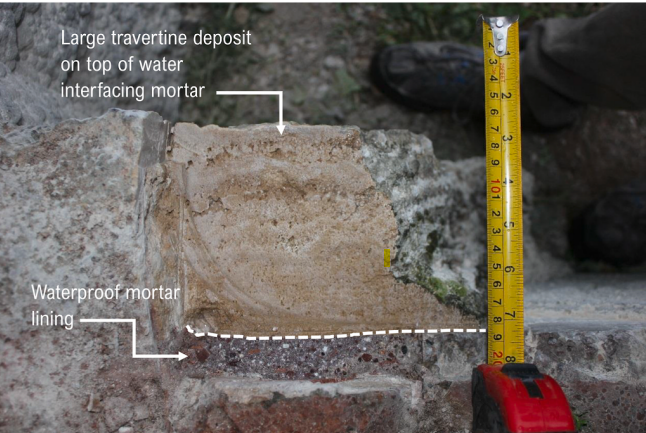
Mortar and concrete, while used differently in the aqueducts, had very similar recipes. The mixture of pozzolana, quicklime, water, and binder pieces was a strong and reliable recipe. From Figure 13, it can be seen how waterproof these mixtures were. They did not allow debris into the water, or did they allow water to escape other than through evaporation. But what made them work so well was the pozzolana and quicklime (Medeghini, 2024).
Quicklime is a product of burned calcium carbonate, which the Romans got from limestone. There is not a lot known about how the Romans made their quicklime, but assumptions can be made. Nonetheless, it is known from Vitruvius’s books that the Roman’s took great care in making their quicklime slack (Moore,1995). It is likely that they used a kiln much like their brick kilns. The kilns had to be around 1090-1370°C, which is known from modern data (Moore,1995). Over a few days in the kiln, the calcium carbonate will burn off carbon dioxide and form calcium oxide, quicklime, see Eq. 1. The product is a soft powdery substance that can be added to other products (Moore,1995).
(Eq. 1) CaCO3 + Heat —> CaO + CO2
Then when quicklime is added with water, it creates calcium hydroxide through a vigorous reaction (Eq. 2). Calcium hydroxide loses water as it dries and becomes calcium oxide (Eq. 3). Calcium Oxide then wants to combine with carbon dioxide which makes the original starting compound of rock, calcium carbonate (see Eq. 4) (Moore,1995).
(Eq. 2) CaO + H2O —> Ca(OH)2 + Heat (Bubbles)
(Eq. 3) Ca(OH)2 – H2O —> CaO
(Eq. 4) CaO + CO2 —> CaO3
On the other hand, pozzolana is a volcanic rock. And it is a volcanic rock that happens to have a great amount of silica (silicon dioxide) and alumina (aluminum dioxide) (Cunningham, 2026). These elements in high amounts create stronger concrete by creating more Calcium Silicate Hydrates (C-S-H) and Calcium Aluminosilicate Hydrates (C-A-S-H) phases (John et al, 2018; Medeghini, 2024). When pozzolana is combined with quicklime slack, Ca(OH)2, it creates the C-S-H and C-A-S-H (Eq. 5).
(Eq. 5) x Ca(OH)2 + y SiO2 + z H2O —> x CaO . y SiO2 . (x + z) H2O
In the waterproofing mortar of the aqueducts, specifically the Aqua Traiana, not only remains where it was placed, but it remains functional chemically (Medeghini, 2024). Mortar samples taken from Aqua Traiana had an amorphous gel with “needle-like formations” that was the reason the mortar worked so well (Medeghini, 2024). This gel is a binder made of C-A-S-H, which makes the concrete strong and holds walls together for centuries. However, C-A-S-H not only makes the mortar strong, but it also allows the mixture to cure under water. This then created the renowned waterproofing material that kept water inside, debris out, and water gliding smoothly to the city. The mixing of pozzolana and quicklime was vital to the making of the aqueducts and the city of Rome overall.
Selant
Selant, much like mortar and concrete, relied on quicklime. But it did not use pozzolana, water, or pottery and rocks. It used olive oil. The reaction between quicklime and olive oil creates a saponification reaction. Saponification is a reaction between a fat and a strong base that forms Glycerol and an acid (Eq. 6) (Mohn, 2023).
(Eq. 6) Ca(OH)2 + Olive Oil —> Glycerol + Calcium Dicarboxylate
This mixture was not rigid like mortar or concrete, the glycerol and, in simple terms, calcium soap, formed a flexible and reliable sealant (Malinowski, 1979). The calcium soap is insoluble and water resistant. Experiments showed that this mixture for sealant showed high compressive strength at 7 days, and an increase in strength at 3 months (Malinowski, 1979). Siphons relied heavily on the olive oil and quicklime sealant. The pressurized system would not have worked without its water and airtight properties, while still being flexible enough to be used in pipes.
Rocks
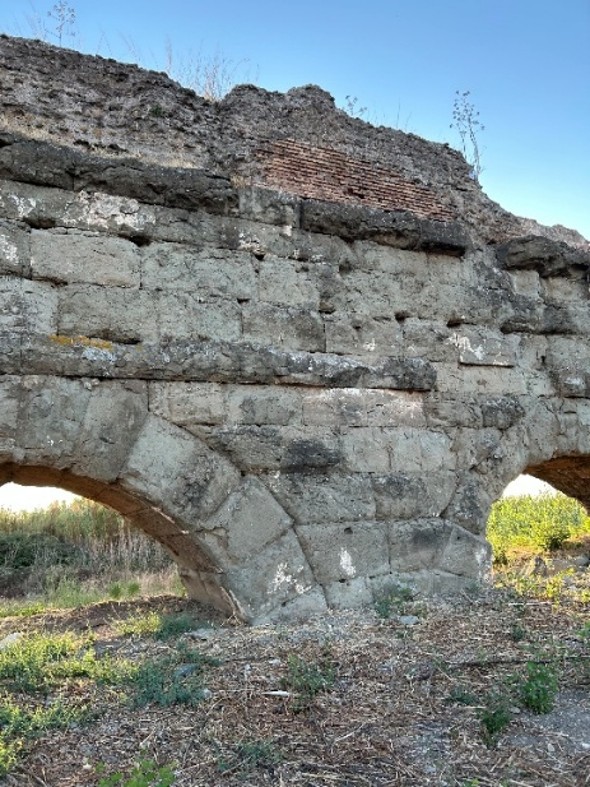
While rocks did not come in constant with the water, much like concrete, their chemistry is still important to understand. Especially because the rocks used for the aqueducts, were seen as a negative. The rocks mainly used for the aqueducts and tunneled through, tuff, are hydrophilic, meaning that the rocks compounds are attracted to water and will dissolve (Acun Özgunler et. al, 2024). The tunnels would dissolve under the constant flow of water. As seen in Figure 14, rain and wind have eroded the tuff blocks that make of the arcade of the Aqua Claudia and Anio Novus. While this piece of the aqueduct still stands, it is damaged from rain. But the rock would be significantly more damaged if it had been under a constant stream in the aqueducts. This is largely why the waterproofing mortar was placed in the tunnels carved through mountains.
Author’s Reflection
In my time exploring, researching, and writing this article, I have been completely enthralled with the aqueducts. They are complete marvels of human engineering born from the need for clean water and then used to show power by controlling water. I wish we knew exactly how they came up with these processes of constructing them and how they used those skills in everyday life. While we can get close by making assumptions using Vitruvius’s books and the human logic of trial and error, it still is not the exact train of thought. Nonetheless, that does not make it any less impressive. Between the quarrying, tunneling, and construction, to the invention of the waterproofing mortar, and the use of the Greek’s sealant, their instinctual understanding of physics is astonishing.
The chemistry behind the gel of the mortar and the soap created by the siphon sealant are also absolutely fascinating to me. I mean, we know that the Romans did not know what an atom was, let alone inorganic and organic chemistry, but they figured it out anyway. And all they knew was that it worked for what they wanted. Whether it was dumb luck, some divine intervention from a water god, or just an observant person, they were chemists before we even had a word for it.
As my essay may show, I am not a civil engineer. I have just been accepted into the chemical engineering major at UW, and that is how I look at these systems. My favorite representation that I have found of my major is bricks. While not necessarily relevant to the chemistry of the aqueduct materials, bricks are an excellent representation of upscaling a known process. The Romans first process of making bricks, as Vitruvius wrote, was molding clay, airdrying it, then using the product to build. But then they upscaled that process to make thousands using kilns because they needed more bricks. They even started using stamps to dictate when they were made. While my simplification does not really do the evolution justice, I think it is an extremely cool representation of the work I will be doing.
Before I go on another rant about my love of history, mythology, and chemistry. And before I get off my Calcium Dicarboxylate box (get it?), I would like to say one more thing. I originally picked the aqueducts for my topic because I thought it would be an easy and well researched topic. It has not been easy, but it has been one of my favorite research assignments ever. Going and standing in an aqueduct tunnel, seeing the still aqueduct fed Trevi Fountain, and randomly finding parts of the arcades all through the city has been a highlight of my time here. I accept that I am a nerd for enjoying studying the chemistry of the aqueducts, and I will proudly wear that badge because the ancient Roman aqueducts are just awesome.
Conclusion
To conclude, the materials of the aqueducts and their chemistry drove the functionality of the system and allowed the aqueducts to still stand today. Without the pozzolana for mortar and concrete and quicklime to make the different sealants, the system would fall apart. So now, while appreciating the endless nasonis, don’t forget where the idea originally came from. And one day, you might even find yourself on the -1 floor of Rinascente, where you want to buy cooking pans for your home. Do not forget to look up from the display to see the Aqua Virgo right in front of you. Because while it was an obstruction to construction, it is living history, physics, and chemistry.
Sources
Acun Özgunler, S., & Karkas, Z. S. (2024). An experimental study conducted to determine the effectiveness and durability of preservation treatments on Volcanic tuff stones. International Journal of Conservation Science, 15(3), 1165–1188. https://doi.org/10.36868/ijcs.2024.03.02
Aicher, P. J. (1995). Guide to the Aqueducts of Ancient Rome. Bolchazy-Carducci Publishers.
Cunningham, M. (2026, Sept. 11). Geological Context of Ancient Rome [Classroom Session]. CEE 409 2026. University of Washington, Rome, Italy.
Delatte, N.J. (2001). Lessons from Roman Cement and Concrete. J. Prof. Issues Eng. Educ. Pract. 127(3). pp. 109-115.
Dembskey, E.J. (2009). The Aqueducts of Ancient Rome. Masters’ thesis in Ancient History. University of South Africa. http://www.romanaqueducts.info/aquapub/dembskey2009Rometxt1.pdf
Flohr, M. (2025). From Ashlar to Brick: Anchoring and Innovation in Roman Building Practice. Anchoring Science and Technology in Greco-Roman Antiquity, 7, 90.
Malinowski, R. (1979, January). Concretes And Mortars In Ancient Aqueducts. Malinowski- AncientConcreteAqueducts. https://case.edu/lifelonglearning/sites/default/files/2020-02/Malinowsky-AncientConcreteAqueducts.pdf
McLennan, R., Keenan-Jones, D., McGowan, G., Zanzi, G., & Buonfiglio, M. (2026a). Diachronic change in Imperial-era waterproof lining technology: Evidence from Pompeii, the Bay of Naples and Rome. Journal of Archaeological Science, 185, 106433. https://doi.org/10.1016/j.jas.2025.106433
Medeghini, L., Calzolari, L., Botticelli, M., Di Fazio, M., De Vito, C., Pettiti, I., Bardelli, F., & Mignardi, S. (2024). The secret of ancient Roman hydraulic mortar: The lesson learnt from the past for future cements. Cement and Concrete Composites, 148, 105484. https://doi.org/10.1016/j.cemconcomp.2024.105484
Murray, A. (2026, Sept. 1). Water [Classroom Session]. CEE 409 2026. University of Washington, Rome, Italy.
Scalenghe, R., Barello, F., Saiano, F., Ferrara, E., Fontaine, C., Caner, L., Olivetti, E., Boni, I., & Petit, S. (2015). Material sources of the Roman brick-making industry in the I and II century A.D. from Regio IX, Regio XI and Alpes Cottiae. Quaternary International, 357, 189–206. https://doi.org/10.1016/j.quaint.2014.11.026
Schram, W. D. (2018, May). Greek and Roman siphons. Siphons in Roman (and Hellenistic) aqueducts. http://www.romanaqueducts.info/siphons/siphons.htm
Stevens, D., & Kington, T. (2013, December 28). Interactive graphic: The aqueducts of Rome. Los Angeles Times. https://graphics.latimes.com/storyboard-la-fg-roman-aqueducts-g/
Vitruvius. (2006, December 31). VITRUVIUS: THE TEN BOOKS ON ARCHITECTURE. eBook of Ten Books on Architecture, by Vitruvius. https://www.gutenberg.org/files/20239/20239-h/20239-h.htm
Wayman, E. (2011, November 16). The secrets of ancient rome’s buildings. Smithsonian.com. https://www.smithsonianmag.com/history/the-secrets-of-ancient-romes-buildings-234992/